

Sustainability on Campus at Carnegie Mellon University Qatar — Operations, Behaviour Change, and a Green Flag
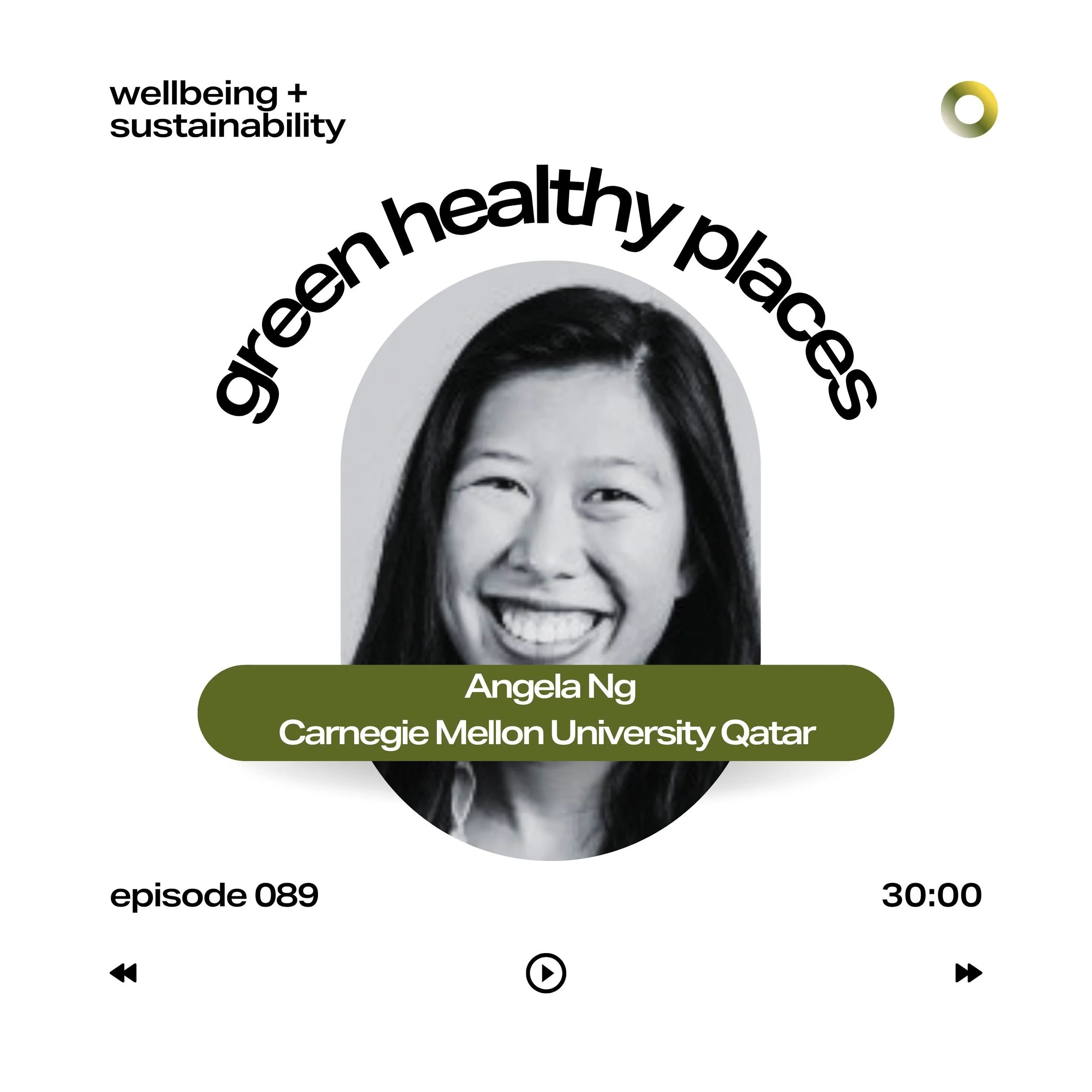
In Episode 89 of the Green Healthy Places podcast, I’m in Doha, Qatar, speaking with Angela Ng, Director of Business Innovation at Carnegie Mellon University in Qatar (CMUQ). Angela’s remit spans campus sustainability, operational efficiency, future planning (including software and AI rollouts), and oversight of new interior projects on campus.
What makes this episode especially useful for building owners and operators is that it focuses on the part of sustainability that most organisations actually live in: the operational phase. The CMUQ building has been in place for years, which means the biggest opportunities are not about redesigning the building from scratch, but about what can be influenced day-to-day—waste streams, procurement, travel, behaviour change, events, partnerships, and measurable engagement.
Listen to Episode 89
Spotify: https://open.spotify.com/show/0OoHv8oT95NNWFgraVSp8v
Apple Podcasts: https://podcasts.apple.com/es/podcast/green-healthy-places/id1522838324
Episode highlights
A practical sustainability framework built around what’s controllable: waste reduction, energy monitoring, procurement, and education.
The complexity of sustainability in Qatar: extreme heat, constant air-conditioning, cheap fuel, and a metro that is underused relative to its quality.
Sustainability implemented through lived campus life: composting, recycling program improvements, gardens, green events, vendor standards, and experiential learning.
CMUQ’s EcoCampus “Green Flag” certification journey—driven by documenting years of initiatives and demonstrating progress, with annual reapplication and KPIs.
An important distinction: EcoCampus is not a prescriptive “points system”; the campus sets its own goals and KPIs, which are then evaluated.
Procurement in the real world: a “green vendor map,” scripts and surveys for suppliers, and the ongoing challenge of consistency, supply chain variability, and greenwashing.
Leveraging university “brain power”: a research dashboard mapping faculty work to SDGs, and student research on recycling barriers and behavioural nudges.
The core reality: sustainability for an existing campus is mostly operational
A key thread in this conversation is the practical constraint most organisations face: once a building is already operating, you cannot easily “rewind” early design and construction decisions. You work within parameters—ownership structure, retrofit constraints, and what is within operational control.
Angela’s approach is to focus on the areas that can meaningfully shift performance and culture in an existing asset: waste, procurement, travel, events, and behavioural norms—while still pushing for innovation and asking “why not?” as a default posture.
Building sustainability culture in Doha: why context matters
Doha presents a unique sustainability context:
Summer temperatures routinely reach 40–50°C, shaping daily life and making outdoor movement difficult for large parts of the year. GHP CMUQ Sustainability -transc…
Air-conditioning is a baseline expectation, including “overcooling” indoors—Angela notes work to reduce the need for people to wear jackets inside. GHP CMUQ Sustainability -transc…
Despite a world-class metro system, cheap fuel influences mobility choices and adoption. GHP CMUQ Sustainability -transc…
“Nature” is perceived differently in a flat desert peninsula; driving environmental protection requires deliberate education and engagement rather than relying on obvious visual cues like forests or mountains. GHP CMUQ Sustainability -transc…
For sustainability leaders, this underlines a crucial point: a campus plan must be culturally and climatically specific. What works in a temperate, seasonal city does not translate directly into a desert environment.
What CMUQ implemented: from gardens, to procurement, to experiential education
Angela outlines a broad portfolio of initiatives, including:
Campus garden and composting
Recycling program revamp and ongoing contamination tracking
Reviewing everyday products (e.g., coffee pods) for sustainability implications
Carbon accounting initiatives (including travel-related considerations)
Experiential education: mangrove kayaking, biodiversity farm tours, tree planting, and sustainability travel learning (including destinations discussed in the episode)
Community clean-ups (beach and desert)
A strong linkage to DEI&B within sustainability practice, including equity considerations for contractors and food provision
“Green guidelines” for events and purchasing, including plastic reduction strategies
The thread connecting these initiatives is a holistic definition: sustainability as something that can be embedded into every role, rather than confined to facilities engineering alone.
The “Green Flag” EcoCampus designation: codifying years of work
One of the most valuable parts of the episode is how the EcoCampus certification process forced a transition from “we do a lot” to “we can evidence it.”
Angela describes a familiar organisational gap: a team may be active and committed, but progress is not codified in one system, dashboard, or plan. In their case, the breakthrough was writing everything down—years of initiatives, decisions, and outcomes—then formalising it into an application that could be audited.
Key points from the episode:
EcoCampus is linked to the Foundation for Environmental Education and introduced locally through Qatar Foundation partners.
The certification process included documentation, external auditor visits, and interviews with students, staff, and leadership.
The designation requires annual reapplication, which becomes a forcing function for KPIs, governance, and continuous improvement.
Angela notes CMUQ as the first in the Middle East / North Africa region to receive the Green Flag EcoCampus designation.
KPIs without the usual rigidity: setting your own success measures
A differentiator of EcoCampus (as described in the episode) is that it is not a rigid checklist in the way that many building certifications are. Instead:
The campus defines goals and KPIs
EcoCampus evaluates progress against the campus’s own defined success indicators GHP CMUQ Sustainability -transc…
Angela mentions examples such as:
Survey results to measure sustainability knowledge and attitudes
Behavioural nudges and measurement of their impact
Waste data tracking (including contamination rates)
Carbon audit baselines and year-on-year targets GHP CMUQ Sustainability -transc…
This is an important operational lesson: when a sustainability plan is built around internally owned KPIs, accountability can be clearer—provided you also invest in consistent measurement.
Procurement in reality: the green vendor map, and why consistency is hard
The vendor section is especially practical for any organisation trying to reduce Scope 3 impacts through purchasing.
Angela describes:
Building a green vendor map based on vendors used in daily operations
Contacting vendors with structured questions and scripts (materials, composting, plastic use, sourcing, delivery emissions)
Creating a usable spreadsheet that staff can filter based on sustainability criteria and distance
Overlaying the dataset into a map interface for ease of use
And then the real-world constraints:
Limited availability of truly sustainable products in-market
Everyone ordering the same “sustainable” products once a shortlist exists
Greenwashing and weak lifecycle analysis (e.g., “wood” as a claim without robust impact data)
Decentralised purchasing, where departments order independently, leading to inconsistency
Vendor compliance variability order-to-order, requiring follow-up and spot checks
This is the honest procurement reality: standards are necessary, but so is verification and iteration.
Using university research capacity as a sustainability tool
Angela explains how CMUQ uses its academic ecosystem to support sustainability:
A sustainability research dashboard mapping faculty research to specific SDGs
Research in areas including AI/robotics for greenhouse farming, and studies on perception of nature and biodiversity in Qatar
Student research on recycling barriers and behavioural nudges, leading to publishable outcomes
This is a strong model for campuses: sustainability becomes a living lab—operational data informing research, and research informing operational changes.
Practical takeaways for sustainability leaders in existing assets
Treat sustainability as an operational system, not a design-only problem.
In challenging climates, behaviour change and education are not “soft extras”; they are core to the strategy.
If you cannot evidence your initiatives, you will struggle to scale them—codify work into dashboards, plans, and KPIs.
Procurement is a long game: build standards, map vendors, and expect verification cycles.
Leverage internal expertise: faculty and student projects can materially accelerate progress when aligned to real operational challenges.
FAQ
What is a university sustainability plan?
A university sustainability plan is an operational and strategic framework for reducing environmental impact and improving social outcomes across campus life—covering energy, waste, procurement, travel, education, and engagement initiatives. GHP CMUQ Sustainability -transc…
What is EcoCampus “Green Flag” certification?
In this episode, EcoCampus is described as a program linked to the Foundation for Environmental Education that evaluates a campus’s sustainability progress against goals and KPIs the campus defines, with auditing and annual reapplication. GHP CMUQ Sustainability -transc…
How do you measure sustainability progress in an operational building?
Approaches discussed include waste tracking (including contamination), survey-based attitude/knowledge measurement, behaviour-change testing, carbon audit baselines, and year-on-year targets. GHP CMUQ Sustainability -transc…
Why is sustainable procurement difficult to implement consistently?
Because purchasing is often decentralised, vendor practices vary over time, supply chains shift, and greenwashing is common—requiring standards, verification, and ongoing follow-up. GHP CMUQ Sustainability -transc…
How can universities use research to support sustainability?
By aligning faculty and student research to operational challenges (e.g., waste behaviours, climate perception, data dashboards) and mapping research outputs to SDGs, sustainability becomes a real-world living lab. GHP CMUQ Sustainability -transc…