

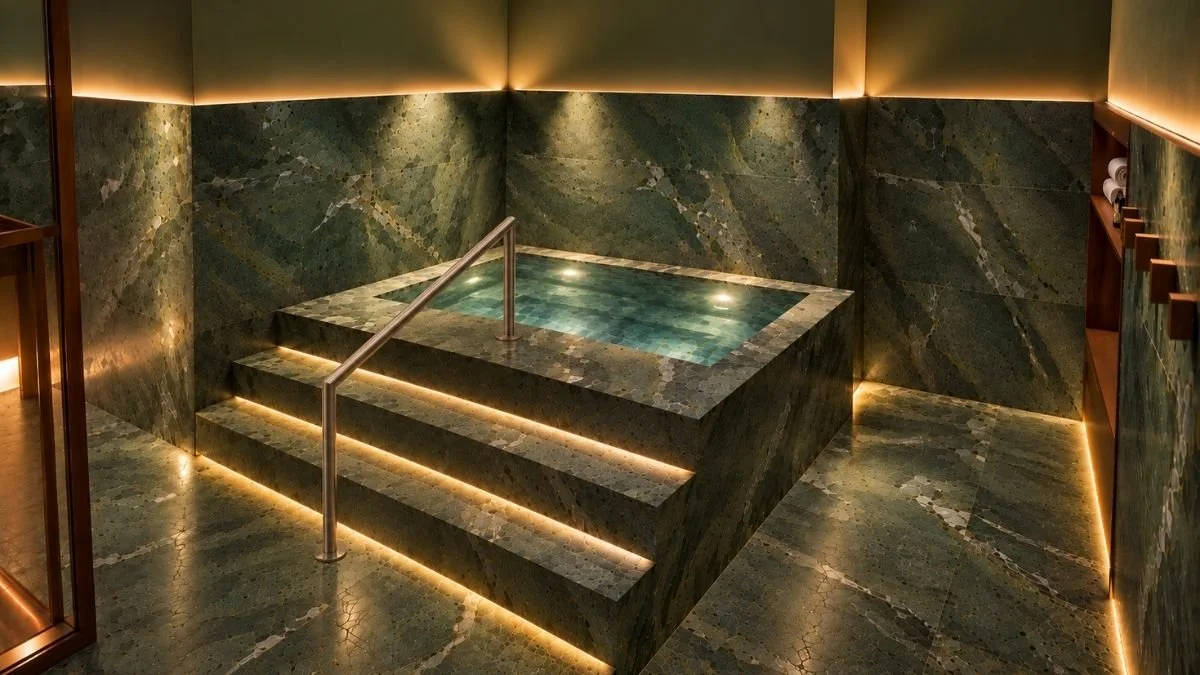
The contemporary bathhouse is emerging as a distinct proposition within the expanding wellness real estate sector. Drawing on longstanding bathing traditions while responding to modern expectations around health, recovery and social connection, it occupies an increasingly interesting position between the traditional spa, private health club and specialist recovery studio.
For developers, investors and destination owners, the significance extends beyond another category of wellness facility. The contemporary bathhouse presents an opportunity to reconsider how wellness is integrated into urban neighbourhoods, hospitality developments and mixed-use destinations, potentially combining commercial activity, community engagement and a distinctive sense of place.
Its appeal lies partly in its simplicity. Unlike wellness concepts built around specialist technologies or complex clinical interventions, bathing is an established cultural practice. Heat, water, rest and social interaction provide the foundations of the experience, although contemporary operators are increasingly interpreting these elements through more sophisticated environments, programming and service models, as well as adding in an extra layer of wellness tech.
From traditional bathing culture to contemporary wellness
Communal bathing has a long history across different cultures. Roman thermae, Turkish hammams, Japanese onsen and Nordic sauna traditions each developed their own relationship between water, heat, ritual and social life.
While their architectural forms and cultural practices differ considerably, they share an important characteristic: bathing has historically served purposes beyond personal hygiene. It has also provided opportunities for relaxation, social interaction and participation in shared cultural rituals.
The contemporary bathhouse draws selectively from these traditions, often combining hot and cold experiences, steam, sauna, immersion pools, float tanks and relaxation spaces within a carefully designed environment.
Some concepts remain closely connected to traditional bathing practices. Others incorporate treatment rooms, guided thermal circuits, on-site food and beverage (especially in banya-style spaces), movement studios or selected recovery technologies.
What distinguishes the bathhouse from a conventional collection of wellness amenities is the extent to which the experience itself becomes the central proposition.
Visitors are not necessarily purchasing access to individual pieces of equipment or booking a conventional spa treatment. They are participating in an experience organised around a sequence of spaces, temperatures, activities and opportunities for rest. This distinction has implications for both the physical design and commercial positioning of the facility.

A different proposition from the spa, health club or recovery studio
The terminology surrounding contemporary wellness facilities has become increasingly fluid. Spas, wellness clubs, recovery studios and longevity centres frequently incorporate overlapping services, making it difficult to distinguish between operating models based on their equipment schedules alone. The bathhouse nevertheless offers a recognisable point of differentiation.
A traditional day spa is often organised around individual treatments, with private treatment rooms forming an important component of its commercial model. A health club typically centres on exercise, supported by changing facilities, recovery amenities and sometimes a spa. Recovery studios tend to focus on specific modalities, often delivered through relatively short, structured appointments.
Longevity studios may incorporate diagnostics, preventative health services, clinical expertise and specialist technologies, depending on their positioning. The contemporary bathhouse, by contrast, can place communal hydrothermal experiences at the centre of its offer.
The commercial proposition may be built around admission to a sequence of bathing environments, supported by optional treatments, guided sessions, memberships or hospitality services, often but not always spread over an extended visit of 2-3 hours.
These distinctions are not absolute. Hybrid models are increasingly common, and the strongest concepts may combine elements from several categories. Nevertheless, understanding the primary purpose of the facility is essential when evaluating its role within a wider development.
A bathhouse designed principally as a social destination will have different spatial, operational and commercial requirements from a private recovery club or medically oriented longevity centre.
The bathhouse as a destination anchor
For mixed-use developments, one of the more compelling characteristics of the bathhouse is its potential to function as a destination in its own right. Unlike a conventional residential gym or private spa amenity, a commercially operated bathhouse can potentially attract users from beyond the immediate development. This creates opportunities to establish a distinctive destination identity, encourage repeat visitation and support complementary uses.
Depending on its location and business model, a bathhouse might form part of a hotel, waterfront destination, urban regeneration project, residential neighbourhood or larger lifestyle-led development. Its relationship with surrounding uses becomes particularly important.
Food and beverage, landscaped outdoor spaces, pedestrian connections and adjacent leisure facilities can reinforce the overall experience. A bathhouse located within a well-considered public realm strategy may contribute to a wider destination proposition rather than operating as an isolated wellness facility.
The potential value therefore extends beyond the direct revenue generated by the operator. A distinctive wellness destination may contribute to the perception of a development, its market positioning and the range of experiences available to residents, guests and visitors.
These wider benefits should not, however, be assumed. Their significance depends on the strength of the concept, the local market, accessibility, operating model and relationship with the surrounding development.
Social wellness and the value of shared experiences
One especially topical reason the contemporary bathhouse warrants attention is its relationship with social wellness. Much of the recent growth in specialist wellness has focused on individual optimisation: personalised fitness, recovery technologies, diagnostics and performance monitoring.
These services have their place, but they often position wellbeing as an individual pursuit. Bathing environments offer a different model, in which restoration and social interaction can coexist comfortably.
The experience may include conversation, communal relaxation and shared rituals, alongside quieter spaces for privacy and contemplation. This balance between collective and individual experience is an important part of the proposition.
For destination developers, the implications are especially relevant to placemaking as successful destinations need reasons for people to visit, return and spend time beyond the immediate transaction. A bathhouse with a strong local membership base, thoughtful programming and complementary hospitality can potentially contribute to these patterns of use.
However, the social character of the facility must be deliberately established. A quiet, contemplative bathhouse and a socially oriented urban bathing club may share similar hydrothermal equipment while delivering very different experiences. Positioning, programming and spatial planning need to reflect that distinction.
Commercial positioning must precede amenity planning
The increasing visibility of contemporary bathhouses should not lead developers to treat them as another fashionable addition to an expanding wellness amenity schedule. Their viability depends on a series of fundamental decisions.
Who is the intended audience? Is the facility primarily for residents, hotel guests, local members or destination visitors? Will access be based on individual admission, memberships, guided sessions or a combination of these?
What is the anticipated relationship between peak occupancy, dwell time and available capacity? How will staffing, cleaning, water treatment, maintenance and energy requirements influence the operating model?
Hydrothermal facilities can be capital-intensive and technically demanding. Pools, saunas, steam rooms and associated plant introduce significant requirements for water treatment, ventilation, waterproofing, servicing and ongoing maintenance.
Consequently, the commercial feasibility of a bathhouse cannot be assessed solely through its appeal as a lifestyle concept. The facility needs a coherent relationship between positioning, capacity, pricing, capital investment and operating expenditure. For developers considering a bathhouse as part of a larger project, these questions belong at the earliest stages of development strategy, before the architectural brief and equipment schedule become fixed.
From amenity provision to destination identity
The renewed interest in bathing culture reflects a broader evolution in the wellness sector. Rather than simply adding more facilities to existing developments, operators and developers are exploring concepts organised around particular experiences, communities and ways of spending time.
The contemporary bathhouse is one expression of this shift. Its potential lies not in the number of saunas, pools or treatment rooms provided, but in the clarity of the overall proposition. When successfully positioned, it can become a recognisable destination with its own identity, audience and commercial logic.
For real estate developers, the relevant question is therefore not simply whether a bathhouse would be an attractive amenity. It is whether a contemporary bathing concept has a credible role within the development’s positioning, market and long-term operating strategy. That is where the opportunity becomes a matter of wellness real estate strategy rather than simply wellness facility design.
Green Healthy Places advises developers, investors and destination owners on wellness real estate strategy, destination positioning, placemaking and amenity planning.
Our work helps development teams evaluate how wellness concepts can support commercial positioning, user experience and the wider destination proposition before progressing into detailed design.
CONTACT US HERE TO DISCUSS A NEW PROJECT
This article was written by Matt Morley, founder of Green Healthy Places and a TEDx speaker.