

Public Realm Is Part of the Brand for Mixed-use Developments
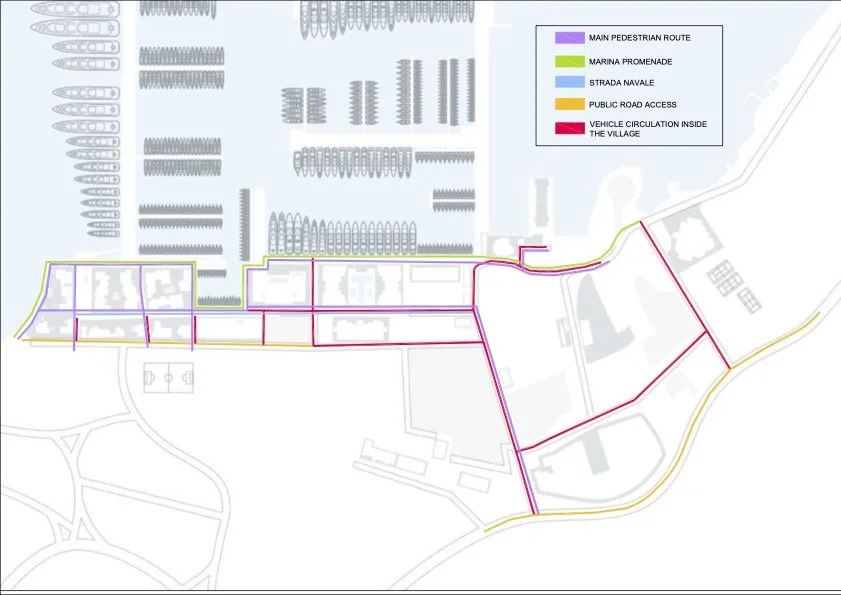
Porto Montenegro village map_pedestrian road access
When developers and operators think about brand, they usually focus on the obvious elements: the name, the visual identity, the architecture, the marketing materials, the leasing mix, perhaps the signage and website. All of those matter. But in many mixed-use destinations, hotels, resorts and waterfront developments, one of the strongest expressions of brand is often treated as secondary.
That expression is the public realm.
Before a guest enters the hotel lobby, before a resident reaches the front door, before a customer steps into a shop or restaurant, they have already formed an impression of the place. They have experienced the arrival sequence. They have noticed the planting, the paving, the terraces, the thresholds, the seating, the lighting, the maintenance standards and the overall sense of coherence, or lack of it.
In other words, they have already encountered the brand.
That is why public realm should not be treated as background infrastructure or a maintenance issue alone. It is part of the brand itself.
Why this matters in premium destinations
In higher-end destinations, expectations are shaped quickly. People may not consciously analyse why one place feels polished and another feels slightly underwhelming, but they notice the difference immediately.
A premium destination can be weakened by surprisingly ordinary things: fragmented planter types, tired landscape edges, weak arrival moments, generic outdoor furniture, poor transitions between zones, or an external environment that feels operational rather than curated. None of these issues may seem major in isolation. Together, however, they can dilute the perception of quality.
This is where many projects fall short. Significant effort may have gone into the architecture, interior design, tenant mix or brand narrative, yet the outdoor spaces still feel inconsistent, unresolved or under-invested. The result is a disconnect between what the place is trying to say and what it actually communicates on arrival.
Public realm is often where premium positioning is either reinforced or quietly undermined.
People judge a place before they enter a building
This is particularly true in mixed-use environments, hospitality-led developments and destination districts. The user journey does not begin at reception or at the restaurant table. It begins outside.
The quality of the approach matters. So does the transition from one zone to another. So do the small moments that define how a place feels at pedestrian level.
A strong public realm does several things at once. It improves first impressions. It creates legibility. It signals care. It frames the experience of arrival. It helps different parts of a destination feel connected to one another. It also supports dwell time, comfort and visual identity in ways that are subtle but commercially meaningful.
Planting, in particular, plays an important role here. Not because greenery is automatically beneficial in every context, but because well-considered planting can soften thresholds, structure movement, enrich views, create seasonal interest and support a more recognisable sense of place. Equally, poor planting or inconsistent landscape elements can make even a strong scheme feel generic.
The public realm carries the brand in physical form
Brand in the built environment is not only verbal or graphic. It is spatial, material and experiential.
A place communicates its brand through the consistency of its physical language. That includes how it handles arrival moments, how public-facing edges are treated, how terraces spill into shared space, how routes are framed, and how planting and streetscape elements support the wider atmosphere.
If a destination wants to be perceived as refined, coherent and premium, the public realm needs to express those qualities with the same discipline as the buildings themselves.
That does not necessarily mean over-designing everything or increasing cost across the board. In fact, some of the most effective public realm improvements come from greater selectivity and consistency. A restrained palette of well-chosen materials, stronger threshold moments, better organised planters, more legible pedestrian routes and a clearer hierarchy of intervention can often do more than a long list of isolated decorative gestures.
What matters is that the external environment feels intentional.
Common signs that the public realm is weakening the brand
One of the reasons public realm is often overlooked is that underperformance tends to happen gradually. It rarely presents as a single dramatic flaw. More often, it appears as an accumulation of smaller issues that reduce perceived quality over time.
Typical signs include inconsistent planter families, weak or underwhelming arrival points, fragmented retail frontages, poor planting composition, generic landscape responses in prominent locations, lack of coherence between hospitality and public-facing areas, and a visible gap between design intent and day-to-day upkeep.
These issues are not merely aesthetic. They shape how residents, guests, visitors and commercial tenants experience the place. They influence whether a destination feels memorable, curated and premium, or simply functional.
That is why public realm deserves strategic attention early and continuously, not just occasional maintenance-led intervention.
Public realm is not only visual. It is commercial
There is also a business dimension to this.
In hospitality and mixed-use settings, the external environment affects how people move, where they pause, how long they stay, and how they perceive the value of the destination overall. A better arrival sequence can strengthen first impressions. A better terrace edge can improve the dining experience. A more coherent retail frontage can lift the perceived quality of a commercial cluster. A stronger pedestrian connection can make the place feel more navigable and complete.
These are not minor matters. They influence experience, dwell time and commercial performance.
Seen in this light, public realm is not decorative surplus. It is part of the operational and commercial infrastructure of the destination.
A strategic approach is needed
Treating public realm as part of the brand also changes how improvement projects should be approached.
Rather than thinking only in terms of broad beautification or generic upgrades, the better question is where the most important intervention points actually are. Which arrival moments matter most? Which thresholds are underperforming? Which public-facing edges are out of step with the desired brand positioning? Which small physical changes could create the greatest uplift in perception?
This is where strategy becomes valuable. Not every space needs the same level of investment. Not every intervention needs to be large. But the most visible and brand-critical parts of the site should be identified and treated accordingly.
That might mean prioritising a hotel frontage, a key retail cluster, a restaurant terrace sequence, a waterfront node or a principal pedestrian connection. Often the most effective public realm strategy is not about doing everything at once. It is about focusing on the areas where public perception is most concentrated.
Final thought
A destination is not judged only by its buildings, its tenant mix or its marketing narrative. It is judged by how it feels on the ground.
That feeling is shaped in large part by the public realm.
For developers, owners and operators, this means public realm should be treated less as a secondary layer and more as a strategic expression of brand, identity and quality. When it is coherent, well-prioritised and properly implemented, it can materially elevate a place. When it is neglected, fragmented or generic, it can quietly erode everything the wider project is trying to achieve.
Public realm is not the background.
It is part of the brand.